This is an old revision of the document!
Chapter 7
- Matching in bipartite graphs can model situations in which objects are being assigned to other objects
- Nodes in X represent jobs, and the nodes in Y represent machines, and an edge (xi,yj) indicates that machine yj is capable of processing job xi.
- Perfect Matching: a way of assigning each job to a machine that can process it
- Property that each machine is assigned exactly one job
- One of the oldest problems in combinatorial algorithms: determining the size of the largest matching in a bipartite graph G
- Network Flow Problems: includes the Bipartite Matching Problem as a special case
7.1 The Maximum-Flow Problem and the Ford-Fulkerson Algorithm
The Problem
- Transportation Networks: networks whose edges carry some sort of traffic and whose nodes act as “switches” passing traffic between different edges
- capacities on the edges
- source nodes in the graph, which generate traffic
- sink (or destination) nodes, which can “absorb” traffic as it arrives
- traffic, which is transmitted across the edges
- Flow Networks
- traffic = flow
- associated with each edge e is a capacity, ce
- single source node s in V
- single sink node t in V
- all other nodes besides s and t are internal nodes
- no edge enters s and no edge leaves t
- at least one edge incident to each edge
- all capacities are integers
- Defining Flow
- s-t flow is a function f that maps each edge e to a nonnegative real number, f
- Flow must follow two properties:
- Capacity: for each e in E: we have 0 ⇐ f(e) ⇐ ce
- Conservation: for each node v other than s and t: sum of the flow value f(e) over all edges entering node v = sum of the flow values over all edges leaving node v
- The Maximum-Flow Problem
- goal: arrange the traffic for maximum efficiency of the available capacity
- given a flow network, find a flow network
- Each “cut” of the graph puts a bound on the maximum possible flow value
- maximum-flow algorithm here will be intertwined with a proof that the maximum flow value equals the minimum capacity of any such division, called the minimum cut.
Designing the Algorithm
- Suppose we start with zero flow: f(e) = 0 for all e
- problem is that its value is 0
- we want to increase the value of f by “pushing” flow along a path from s to t, up to the limits imposed by the edge capacities
- need a general way of pushing flow from s to t to increase the value of the current flow
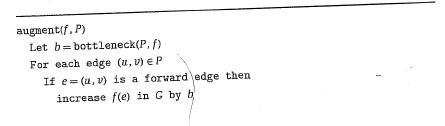
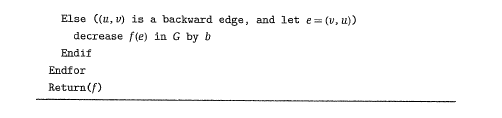
- General: push forward on edges with leftover capacity / push backward on edges that are already carrying flow to divert it in a different direction
- Residual Graph: provides a systematic way to search for forward-backward operations
- Residual Graph
- Residual Graph Gf of G with respect to f:
- The node set of Gf is the same as that of G
- For each edge e = (u,v) of G on which f(e) < ce, there are ce - f(e) leftover units of capacity: forward edges
- For each edge e = (u,v) of G on which f(e) > 0, there are f(e) units of flow that we can undo if we want to: edge e' = (v, u) in Gf
- e' has the same ends as e, but reverse direction: backward edges
- Augmenting Paths in a Residual Graph