Table of Contents
Chapter 6
- In general, most problems do not have a natural greedy algorithm solution that works
- Divide and conquer is often not strong enough to reduce exponential brute-force search down to polynomial time
- Dynamic Programming: one implicitly explores the space of all possible solutions, by decomposing things into a series of subproblems, and then building up correct solutions to larger and larger subproblems
6.1 Weighted Interval Scheduling: A Recursive Procedure
- Each interval has a certain value (or weight), and we want to accept a set of maximum value.
Designing a Recursive Algorithm
- n requests (1,…,n)
- each request i specifies a start time si and finish time fi.
- each request i also has a value or weight (vi)
- compatible intervals: do not overlap
- goal: select a subset of mutually compatible intervals so as to maximize the sum of the values of the selected intervals
- sort requests in order of nondecreasing finish time
- define p(j), for an interval j, to be the largest index i<j such that intervals i and j are disjoint
- leftmost interval that ends before j begins
- p(j) = 0, if no request i<j is disjoint from j
- Optimal solution O: either interval n belongs to O or it doesn't
- if it is, no intervals indexed between p(n) and n can belong to O
- if it is not, O is equal to the optimal solution of request s {1,n-1}
- For any value of j between 1 and n, let Oj denote the optimal solution to the problem consisting of requests {1,…,j} and let OPT(j) denote the value of this solution
- OPT(j) = max(vj + OPT(p(j)), OPT(j-1))
- request j belongs to an optimal solution on the set {1,2,..,j} if and only if vj + OPT(p(j)) >= OPT)j-1)
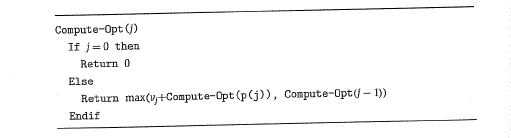
- Compute-Opt Subproblems grow very quickly
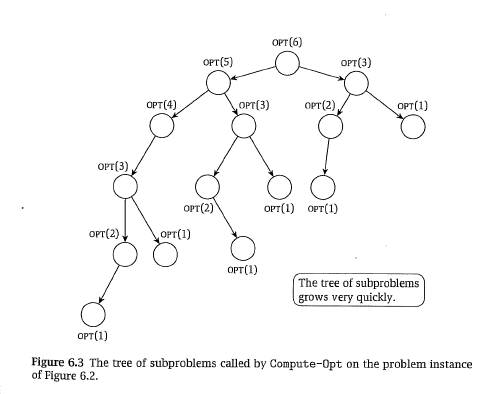
- we have not achieved a polynomial-time solution
Memoizing the Recursion
- Previous algorithm runs in exponential time because of the redundancy of how many times it issues a compute-opt() call
- Memoization: saving values that have already been computed in a globally-accessible place
- Have an array M[0…n], where M[j} will start with the value “empty” and then will store the value of Compute-Opt(j) as soon as it is first determined.
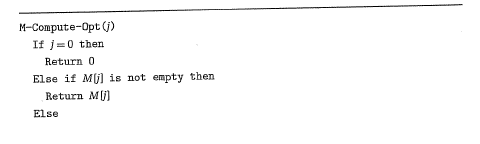

Analyzing the Memoized Version
- Runtime: O(n) ← assuming sorted input intervals by finish times
- Runtime is bounded by a constant times the number of calls ever issued
- No explicit upper bound on the number of calls, so we look for a good measure of “progess”
- Useful progress measure: number of entries in M that are not “empty”
- M has only n+1 entries ← at most O(n) calls
Computing a Solution in Addition to Its Value
- We could maintain an array S so that S[i] contains an optimal set of intervals among {1,2,…,i}.
- If we explicitly maintain S, we increase runtime by an additional factor of O(n)
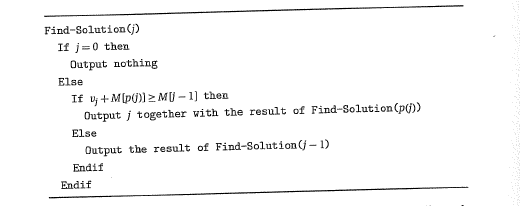
- To avoid this, we recover the optimal solution from values saved in the array M after the optimum value has been computed
- we want to “trace back” through array M to find the set of intervals in the optimal solution
- Find-Solution: calls itself recursively on strictly smaller values, makes a total of O(n) recursive calls and spends constant time per call.
Personal Thoughts
The actual algorithms in this section were a little bit difficult to follow, but the concept of memoization makes a lot of sense to me. I think this week's problem set will help me understand the concept of finding an optimal solution using dynamic programming better.
Readability: 6.0 Interesting: 6.0
6.2 Principles of Dynamic Programming: Memoization or Iteration over Subproblems
Designing the Algorithm
- array M encodes the notion that we are using the value of optimal solutions to the subproblems on intervals {1,2,…,j} for each j
- M[n] contains the value of the optimal solution on the full instance
- Find-Solution can be used to trace back through M efficiently and return an optimal solution itself
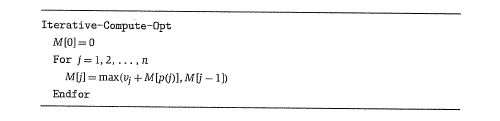
- Can compute the entries in M by an iterative algorithm, rather than using memoized recursion
Analyzing the Algorithm
- Can prove by induction on j that this algorithm writes OPT(j) in array entry M[j]
- As before, we can pass the filled-in array M to Find-Solution to get an optimal solution in addition to the value
- Runtime: O(n) ← explicitly runs for n iterations and spends constant time in each
A Basic Outline of Dynamic Programming
- Iterative building up of subproblems: algorithms are often simpler to express this way
- One needs a collection of subproblems derived from the original problem that satisfies a few basic properties:
- Only a polynomial number of subproblems
- Solution to the original problem can easily computed from the solutions to the subproblems
- Natural ordering on subproblems from “smallest” to “largest,”
- with an easy-to-compute recurrence that allows one to determine the solution to a subproblem from the solutions to some number of smaller subproblems.
- never clear that a collection of subproblems will be useful until one finds a recurrence linking them together
- but also can be difficult to think about recurrences in the absence of the “smaller” subproblems that they build on
Personal Thoughts
The section was short and easy to process, as the information was clear and not overly complicated. I think this section is a good set up for the section that follows, as it sets up a nice foundation. The next section will probably do a better job of applying this conceptual idea to a problem or problems.
Readability: 8.0 Interesting: 6.5
6.3 Segmented Least Squares: Multi-way Choices
- Here, the recurrence will involve “multi-way choices,” meaning it is not necessarily binary.
- Each step has a polynomial number of possibilities to consider for the structure of the optimal solution
The Problem
- Example: line of best fit
- Suppose our data consists of a set P of n points in the plane denoted (x1,y1), (x2,y2),…,(xn,yn) and x1<x2<…<xn
- Given a line L defined by the equation y = ax+b, we say that the error of L with respect to P is the sum of its squared “distances” to the points in P.
- Goal: find a line with minimum error
- But what if using more than one line is better than using just one line of best fit
- Modified Goal: fit the points well, using as few lines as possible
- Change Detection: given a sequence of data points, we want to identify a few points in the sequence at which discrete change occurs
- Formulating The Problem
- partition P into some number of segments
- Each segment is a subset of P that represents a contiguous set of x-coordinates
- For each segment S in our partition of P, we compute the line minimizing the error with respect to the points in S
- The penalty of a partition is defined to be a sum of the following terms:
- number of segments * a fixed, given multiplies (C>0)
- for each segment, the error value of the optimal line through that segment
- as we increase the number of segments, we reduce the penalty in terms of 2, but we increase the term in terms of 1
Designing the Algorithm
- Polynomial number of subproblems, solutions yield a solution to the original problem, build up solutions using a recurrence
- For segmented least squares, the last point pn belongs to a single segment in the optimal partition, and the segment begins at some earlier point pi.
- If we know the identity of the last segment, pi,…,pn, then we could remove those points from consideration and recursively sold the problem on the remaining points p1,…,pi-1
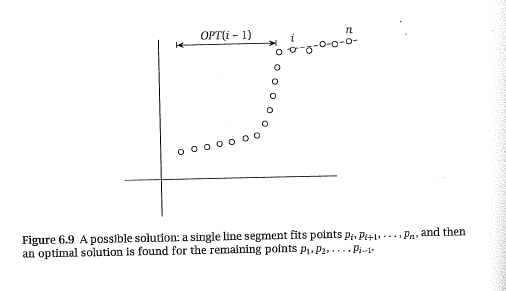
- If the last segment of the optimal partition is pi,…,pn, then the value of the optimal solution is OPT(n) = error of i through n + C + OPT(i-1)
- For the subproblem on the points p1,…,pj,
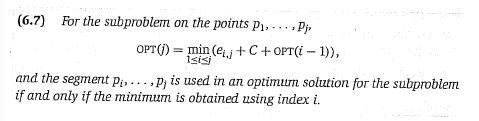
- we can trace back through array M to compute an optimum partition:
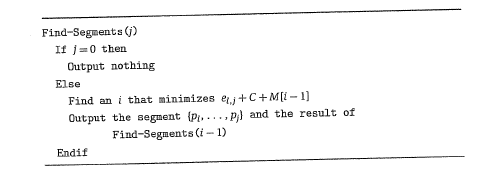
Analyzing the Algorithm
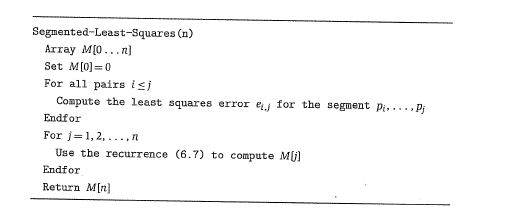
- Runtime of Segmented-Least-Squares: O(n³)
- compute the values of all the least-squares errors e of i through j (eij)
- O(n²) pairs (i,j)
- For each pair, we can compute the error e of i through j in O(n) time
- Algorithm has n iterations j=1,…,n.
- For each value, we have to determing the minimum in the recurrence to fill in the array entry M[j]
- Takes O(n) for each j → total of O(n²)
- Runtime is O(n²), once all error values have been determined.
Personal Thoughts
The section did a really good job laying out the algorithms in a way that was easy to follow. I think the least squares problem is also inherently easier to understand because we have worked with similar problems in math classes before. Overall, I think the algorithms and the data structures needed to solve this problem are pretty intuitive.
Readability: 8.0 Interesting: 6.5